
How to Find North Without a Compass (5 Reliable Methods)
Lost without a compass? Here are five proven ways to find north using the sun, stars, and natural landmarks - plus when to rely on your phone instead.

Finding north without a compass sounds like a survival skill from another era - but it's genuinely useful when your phone battery dies, your GPS fails, or you simply want to understand how navigation worked before electronics.
Here are five methods that actually work, ranked from most to least reliable.
1. Use the Sun (Daytime - Most Reliable)
The sun rises in the east and sets in the west everywhere on Earth. At solar noon - when the sun is highest in the sky - it's due south in the Northern Hemisphere (or due north if you're south of the equator).
The stick method:
- Push a straight stick into the ground on a flat, shadow-free surface.
- Mark the tip of the shadow with a stone.
- Wait 15–20 minutes and mark the new shadow tip.
- Draw a line between the two marks. This line runs roughly east–west. The first mark is west, the second is east.
- Stand with west to your left and east to your right - you're now facing north.
This works anywhere sunlight reaches and is accurate to within a few degrees.
2. The Analog Watch Method
If you have an analog watch (with hands), you can find north quickly on a sunny day.
In the Northern Hemisphere:
- Hold the watch flat and point the hour hand at the sun.
- Bisect the angle between the hour hand and the 12 o'clock mark.
- That bisecting line points south. North is the opposite direction.
In the Southern Hemisphere: Point the 12 o'clock mark at the sun instead, and bisect toward the hour hand.
This method is less accurate near noon and near the equator, but gives you a reasonable bearing within 20–30 degrees.
3. Find Polaris (Night - Highly Accurate)
Polaris, the North Star, sits almost exactly above Earth's geographic North Pole. If you can find it, you have true north within about 1 degree.
How to find Polaris:
- Find the Big Dipper (Ursa Major) - its "cup" shape is distinctive.
- Draw an imaginary line through the two outermost stars of the cup (the "pointer stars").
- Extend that line about five times its own length.
- The bright star you land on is Polaris.
Polaris isn't the brightest star in the sky - it's about 50th - but it's the only one that doesn't appear to move as Earth rotates.
4. Watch Where the Moon Rises and Sets
Like the sun, the moon rises roughly in the east and sets roughly in the west - but its exact position varies significantly with phase and time of year, making this less precise than the solar method. Use it as a rough cross-check, not a primary method.
5. Natural Clues (Least Reliable)
You've probably heard that moss grows on the north side of trees or that tree rings are denser on the south side. These clues exist but are inconsistent enough to be dangerous to rely on - local microclimates, shade from other trees, and soil variation can completely override them.
Use natural clues only to confirm what other methods suggest, never as a standalone technique.
When to Use Your Phone Instead
All five methods above involve trade-offs - they work in good conditions with clear skies, and they take time. If you have any battery left, the magnetometer in your Android phone gives you a real-time, accurate heading instantly with no setup.
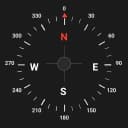
A dedicated compass app also works in airplane mode, uses negligible battery compared to GPS navigation, and shows your exact heading in degrees rather than a vague directional estimate.
The old techniques are worth knowing. Your phone's compass is worth having.
Newsletter
Stay in the loop
New articles and app updates, straight to your inbox.
Keep reading
How Accurate Are Smartphone Compass Apps? (The Real Answer)
Smartphone compass apps vary widely in accuracy. Here's what affects the reading, how to test your phone's compass, and what to expect from modern Android devices.
Navigate Offline: Why Your Phone Deserves a Real Compass App
Most navigation apps are built for cities and cloud connectivity. Here's why a lightweight offline compass app is what you actually need when you step away from the grid.